
Making Middletown Centre for Autism's website work for everyone
Middletown Centre for Autism supports children and young people living with autism, and the parents, carers and teachers around them. For many of those people, the Centre's website is the first place they meet it. They go there to find training, read research or book a place on a course.
If the website is hard to use, it lets down the people it is there to serve. So we have rebuilt it to meet WCAG 2.2 AA, the current version of the Web Content Accessibility Guidelines, and added tools that let each visitor adjust the site to suit their own needs.
A partnership built over 10+ years
We support and maintain Middletown's website and the admin portal their team uses every day. We also built the Middletown mobile app for iOS and Android, which lets people browse and book training, find resources and manage their bookings.
Knowing the platform this well meant we could plan the work around how Middletown actually runs. There was no disruption to bookings, no double entry for their team, and no loss of the content they have built up.
Why WCAG 2.2, and why now?
Accessibility is part of the Centre's core purpose, not an extra. Its audience is wide and varied, and every visitor should be able to find what they need with ease.
There is a regulatory reason too. WCAG 2.2 became the W3C's recommended standard in October 2023. Since October 2024, the UK Government has monitored public sector websites against WCAG 2.2 AA under the Public Sector Bodies Accessibility Regulations.
The Centre wanted a website that met the current standard, stood up to that scrutiny, and showed the same care for its audience as everything else it does.
What WCAG 2.2 asks for, in plain English
WCAG 2.2 is the international standard for web accessibility, published by the W3C. It builds on WCAG 2.1 and adds nine new success criteria, many of which help people with cognitive, motor and low-vision needs. The six new criteria at levels A and AA are:
Focus not obscured: when you move through a page with a keyboard, the item you are on is never hidden behind a sticky header, banner or pop-up.
Target size: buttons and links are big enough, or spaced far enough apart, to tap without hitting the wrong one.
Dragging movements: anything you can do by dragging, you can also do with a simple click or tap.
Consistent help: contact details and help links sit in the same place on every page.
Redundant entry: people are not asked to type the same information twice in one process, such as a booking.
Accessible authentication: signing in does not rely on memory tests or puzzles, and people can paste passwords or use a password manager.
For an audience that includes autistic young people, their families and busy professionals, these are not technicalities. Predictable layouts, clear focus and simpler sign-in reduce stress and make the site easier for everyone to use.
Source: What's new in WCAG 2.2, W3C
What we did
The work had three parts.
An accessibility audit. We tested the existing site against WCAG 2.2 AA, using automated tools alongside manual keyboard and screen reader testing. That gave us 5 critical, 3 major and 1 minor issues to fix, prioritised by their impact on visitors.
A full front-end re-skin. We rebuilt the site's templates, styles and components with accessibility built in from the start. That covered colour contrast, typography and spacing, visible focus states, larger touch targets, consistent navigation, clearer forms and error messages, and properly structured headings and landmarks.
UserWay implementation. We added the UserWay accessibility widget, which lets each visitor adjust the site to suit them. They can change text size, spacing or contrast, pause animations, or switch to a dyslexia-friendly font.
Throughout, content and bookings stayed connected to the admin portal and the mobile app, so the Middletown team kept working as normal.
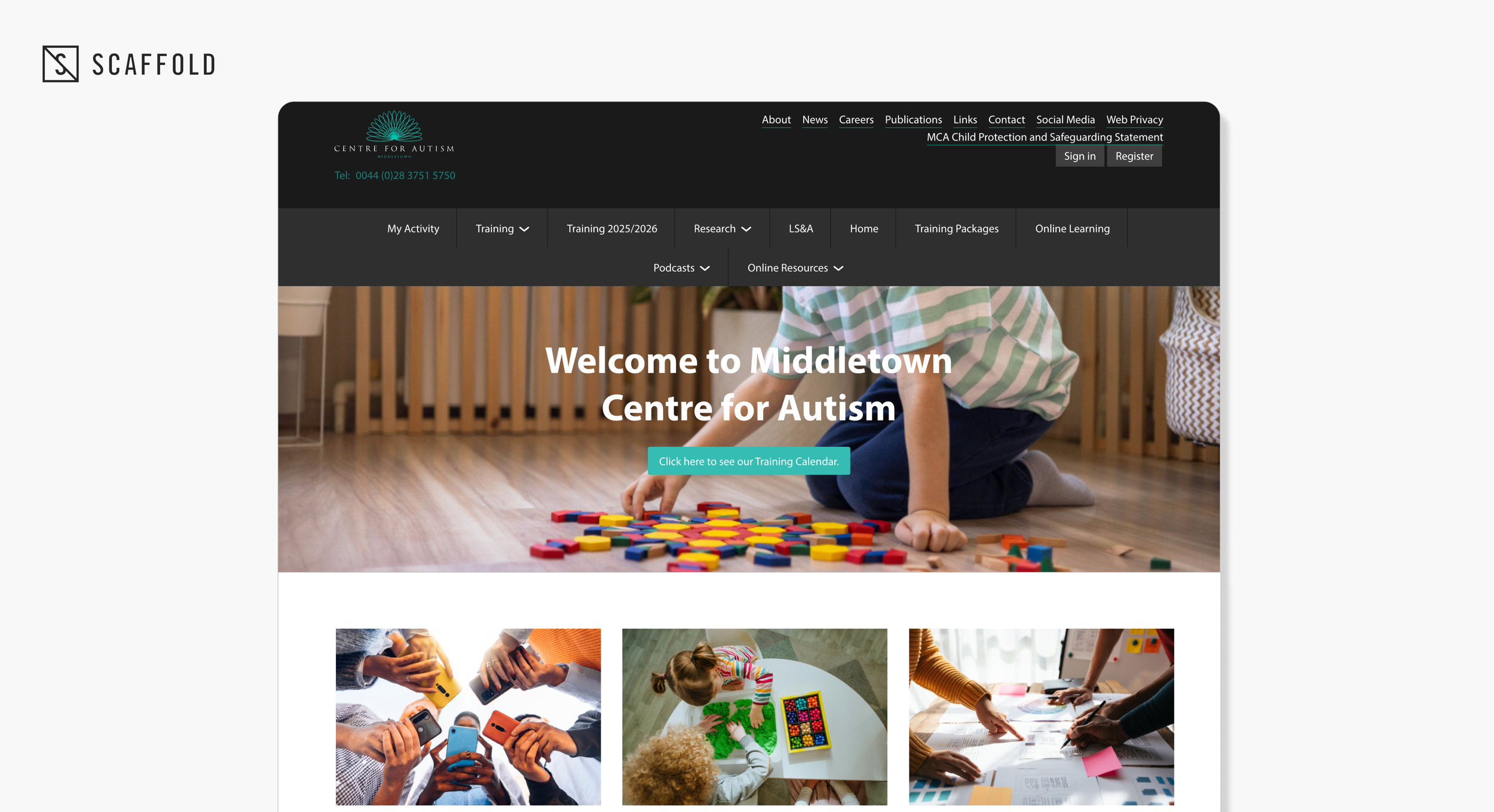
Before
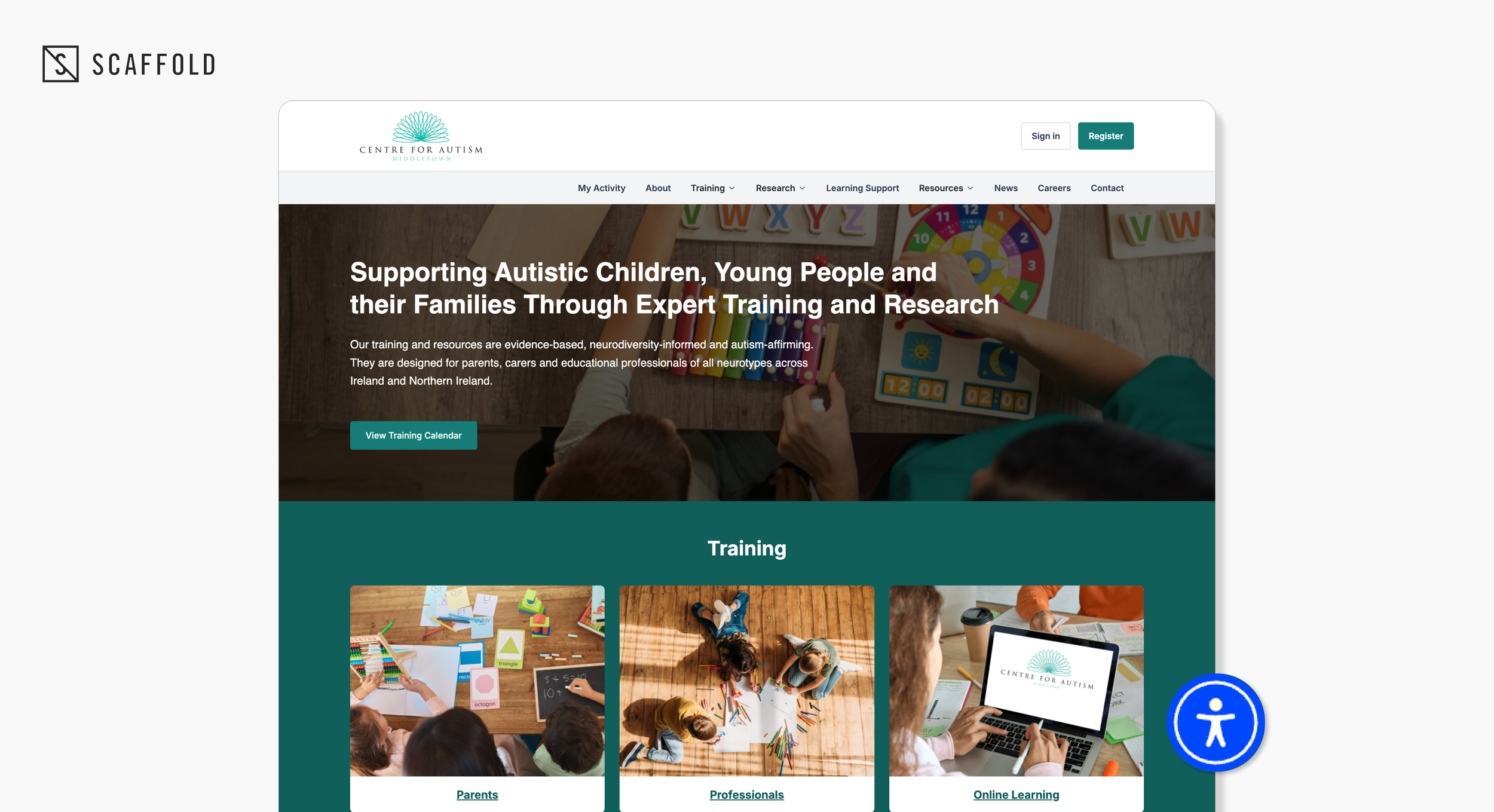
After
Why a re-skin, not a patch
We could have fixed issues one by one. But many accessibility problems live in the design system itself: the colour palette, the button styles, how menus and forms are built. Patching them page by page is slow, and the problems tend to come back when new content is added.
Rebuilding the front end means every page now inherits accessible patterns by default. When Middletown's team publishes a new course or research bulletin, it is accessible without anyone having to think about it.
Where UserWay fits
We are clear with every client that an accessibility widget is no substitute for an accessible website. It complements one. The re-skin is what brings the site in line with WCAG 2.2; UserWay sits on top as an extra layer of choice. We tested it alongside screen readers to make sure it helps rather than gets in the way.
That choice matters for Middletown's audience. Sensory needs vary from person to person: one visitor may want more contrast, another less; one may want animations paused, another larger text. The widget lets people make those adjustments for themselves, without us having to guess.
The result
Middletown's website has been rebuilt and tested against WCAG 2.2 AA. It has a fresh, consistent look and gives every visitor the tools to adjust it to their own needs.
"As a publicly funded organisation, we have a duty to make sure our services are open to everyone, and our website is no exception. Scaffold gave us the confidence to take on improving the accessibility of our digital services, delivered the work without disrupting the families and professionals who depend on us, and continue to support us as standards evolve."
Stephen Douthart, Chief Executive - Middletown Centre for Autism
Accessibility is never finished. As the guidelines evolve and Middletown's content grows, we will keep testing and improving the site as part of our ongoing support.
Facing a new standard or regulation?
When guidelines move on, it can be hard to know where to start, especially for public bodies whose websites are monitored against them. We can help you understand what the change means for your website, plan the work and deliver it without disrupting day-to-day operations. Get in touch to talk it through.
