GETTING A PREDICTION MODEL OUT OF THE RESEARCH PROGRAMME AND ONTO THE BEACH.
Platforms


Work > Swim NI
Sea swimming got popular overnight all across Northern Ireland. By the late 2010s, thousands of people were getting into the water year-round, and the question they all had was… “Is it clean today?” And there was a genuinely good answer that almost nobody could reach.
That answer came out of SWIM NI. Planning and Local Government in Ireland, University College Dublin led it, supported by the Agri-Food and Biosciences Institute and Keep Northern Ireland Beautiful. Between them they built predictive water quality models for six beaches in Northern Ireland and three in the Republic of Ireland.
The science was sound. The distribution was the problem.


THE PROBLEM
Bathing water quality is a public health message, and a public health message that doesn't reach people isn't doing its job.
-

Health Risks
The consequences are all health related. The model exists to warn bathers about intestinal enterococci and E. coli, and exposure means gastroenteritis and ear infections rather than an inconvenience. That set the bar for accuracy, and for how plainly the answer had to be stated. "Excellent" or "poor", from a source people could trust, with no interpretation required.
-

Timed Information
The existing route to the public didn't match how people decide. Predictions were published through the Keep Northern Ireland Beautiful website and onsite electronic beach signs. A sign tells you once you have already driven there and parked. A website assumes you thought to check before you left. Neither reaches the person deciding at 7am whether today is the day.
-

Real-Time Predictions
Laboratory results lag reality. Samples are collected weekly and cultured, which takes up to 48 hours. By the time a result is confirmed, the conditions that produced it have moved on. The predictive model existed precisely because sampling alone can't answer the question in time, but only if the prediction gets to someone before they get in the water.
-

Seasonal Launch
There was a season to hit. The bathing season runs from 1 June to 15 September. Miss the start of it and the app waits a year for its first real users.
WHAT WE BUILT
What Swim NI needed wasn't an app that displayed water quality. They needed a durable public channel for a prediction model and one that could survive the research programme that created it.
Cross-platform mobile apps fed by the live prediction model, with a content management system the partners run themselves.
-
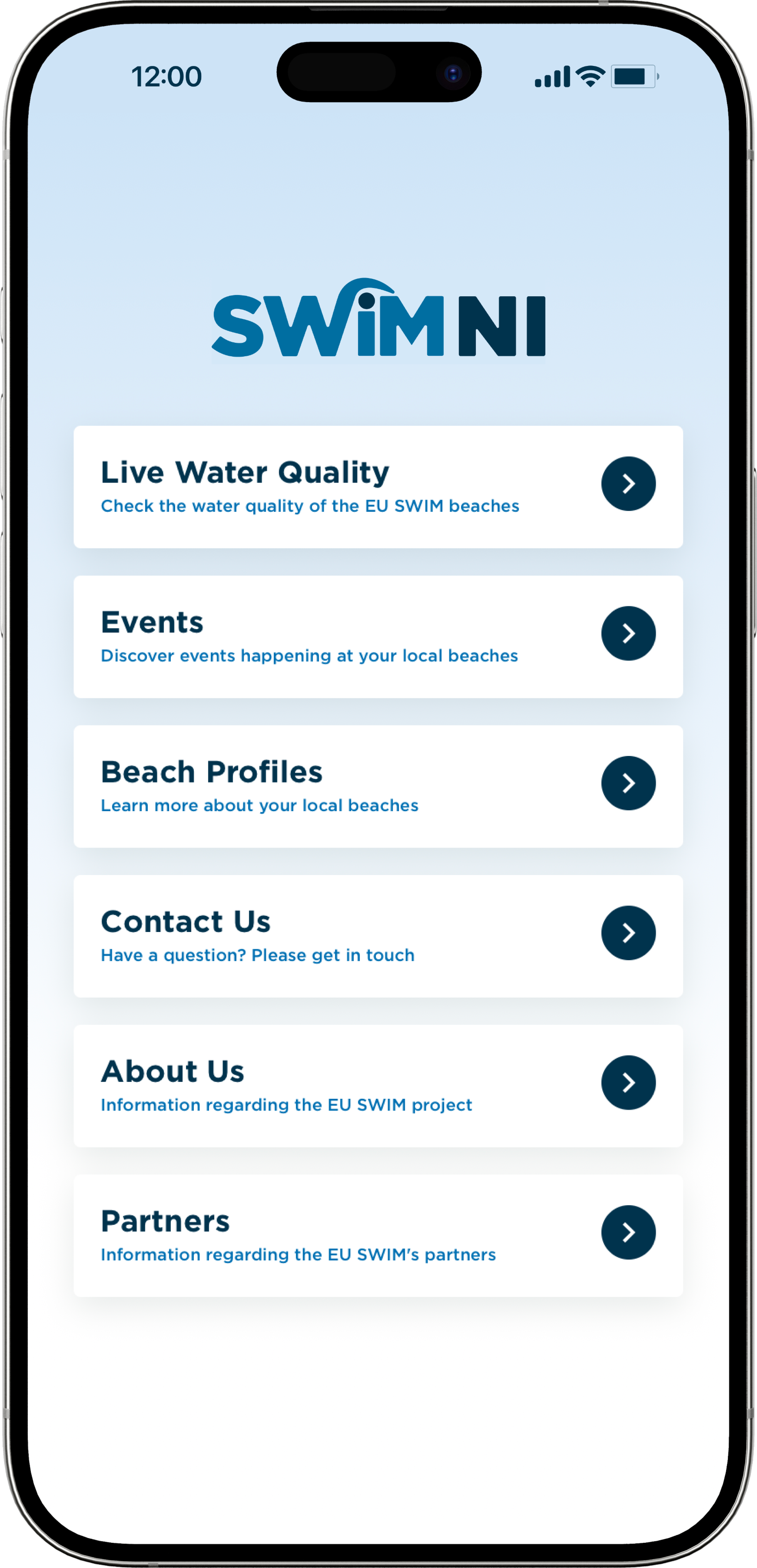
01. iOS and Android from a single codebase.
Built in Ionic, so one build serves both platforms and can be deployed as a progressive web app. On a fixed-term research budget, maintaining two native codebases would have consumed money that needed to go into the years after launch.
-
02. A live connection to the prediction API.
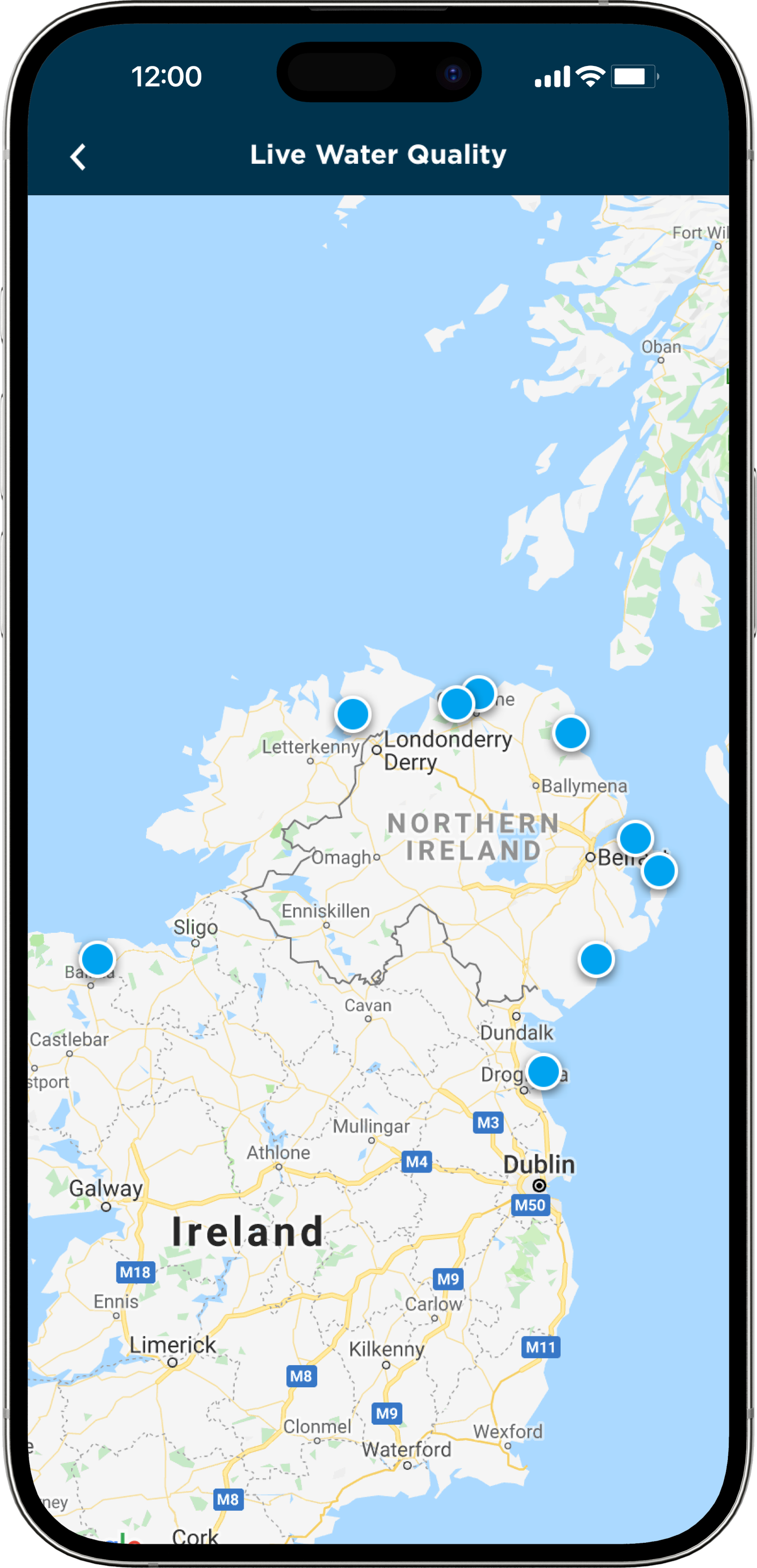
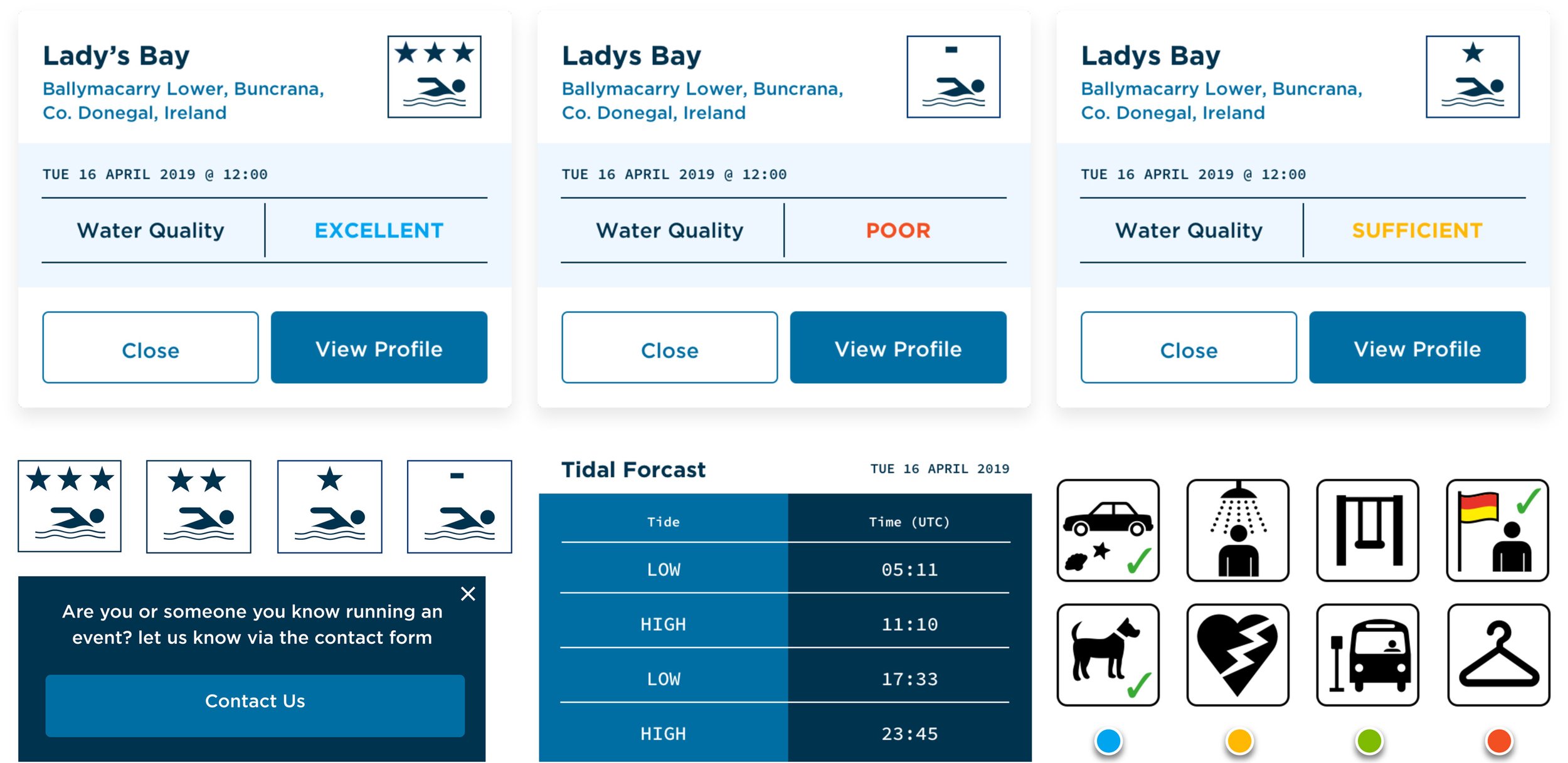
Daily water quality classifications come straight from the model, alongside water temperature and tidal forecasts. The app displays the science, it doesn't second-guess it.
-
03. Interactive maps of the bathing sites.
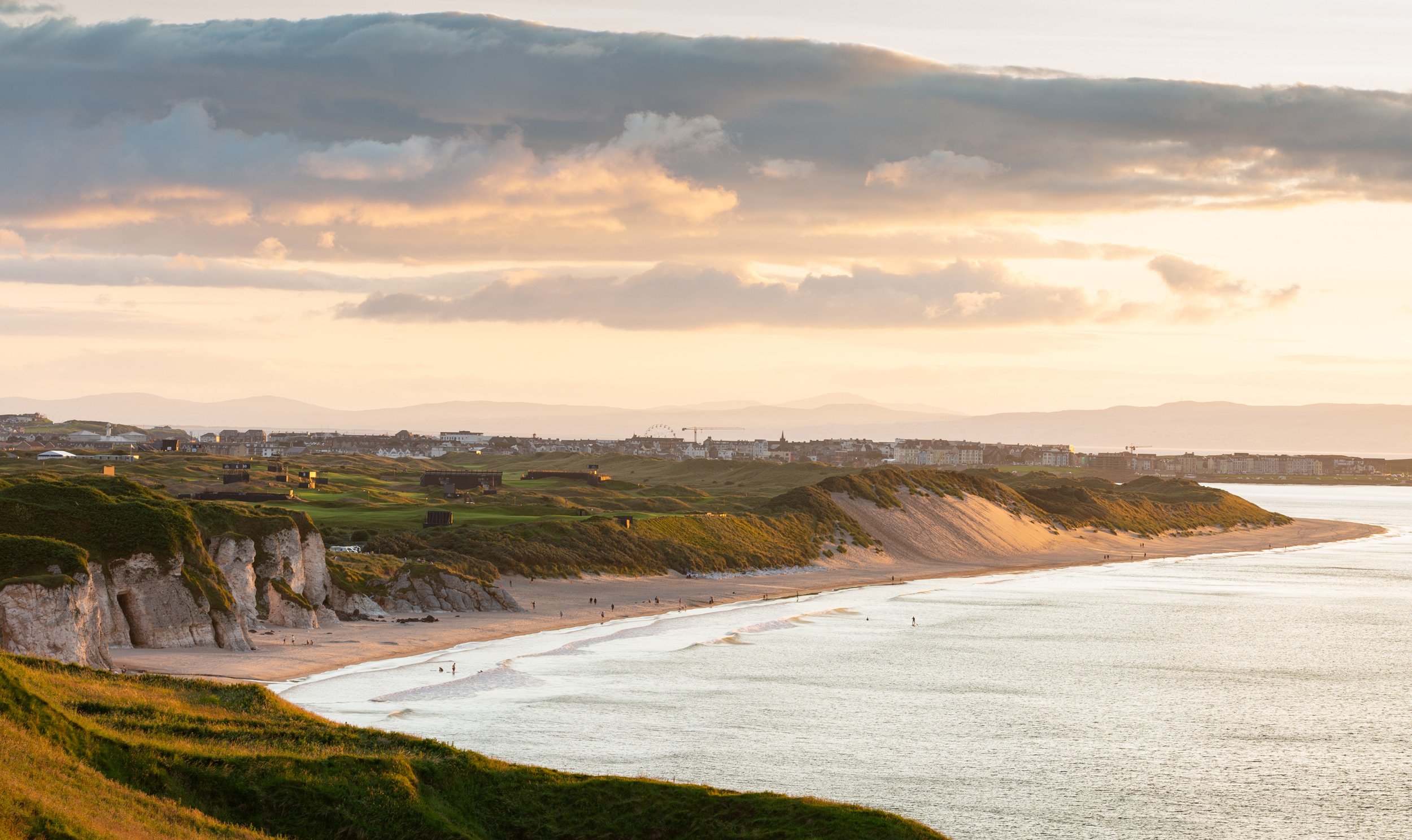
Ballyholme, Ballywalter, Castlerock, Newcastle, Portrush and Waterfoot, each with current water quality, accessibility information, directions and nearby amenities. People discover new places to swim through the app rather than only checking the one they already use.
-
04. A Laravel based content management system, deliberately separate from the data feeds.
Events, beach profiles, partner and funder information are all managed by the communications partner directly. The editorial layer and the science pipeline are independent, which means updating a beach description can never disturb the prediction feed, and neither one waits on the other.
-
05. Cloud infrastructure and ongoing support.
Load through a summer weekend looks nothing like load in February, and the app has to be there on the days it matters most.

"We were very pleased with the app delivered by Scaffold Digital in ease of use and the fact it is a niche area the download figures have been good."
Jade Berman / Local environmental quality manager, Swim NI
WHAT CHANGED
01.
Discovery, build and launch were completed in twelve weeks, in time for the opening of the bathing season and the summer that followed it.
02.
Swimmers get a daily prediction for the specific beach they are heading to, wherever they happen to be when they decide, rather than finding out at the car park.
03.
The communications partner updates beach content, events and partner information without a developer, throughout the season.
04.
When DAERA publicly urged people to use the app and the story reached BBC NI headlines, downloads rose more than 1,700% in a day and the platform handled it.
WHY IT WORKED
The useful question wasn't how to display water quality data. It was where a person actually is when they need it, and what would still be true about this service in five years.
Those two questions produced the decisions that mattered: Mobile first, because the decision gets made at home or in a car park rather than at a desk; a single codebase, because the money had to stretch past the funded programme; and a hard separation between the live prediction feed and the editorial content, because the partners running each were always going to change independently of one another.
That last decision is the one that earned its keep. The research programme ended, the lead partner handed over, the funding line changed, the name changed. The app kept working through all of it, because none of those things were baked into how it was built.



-

Discovery & Strategy
-

Software Development
-

Cloud Infrastructure
-

Support